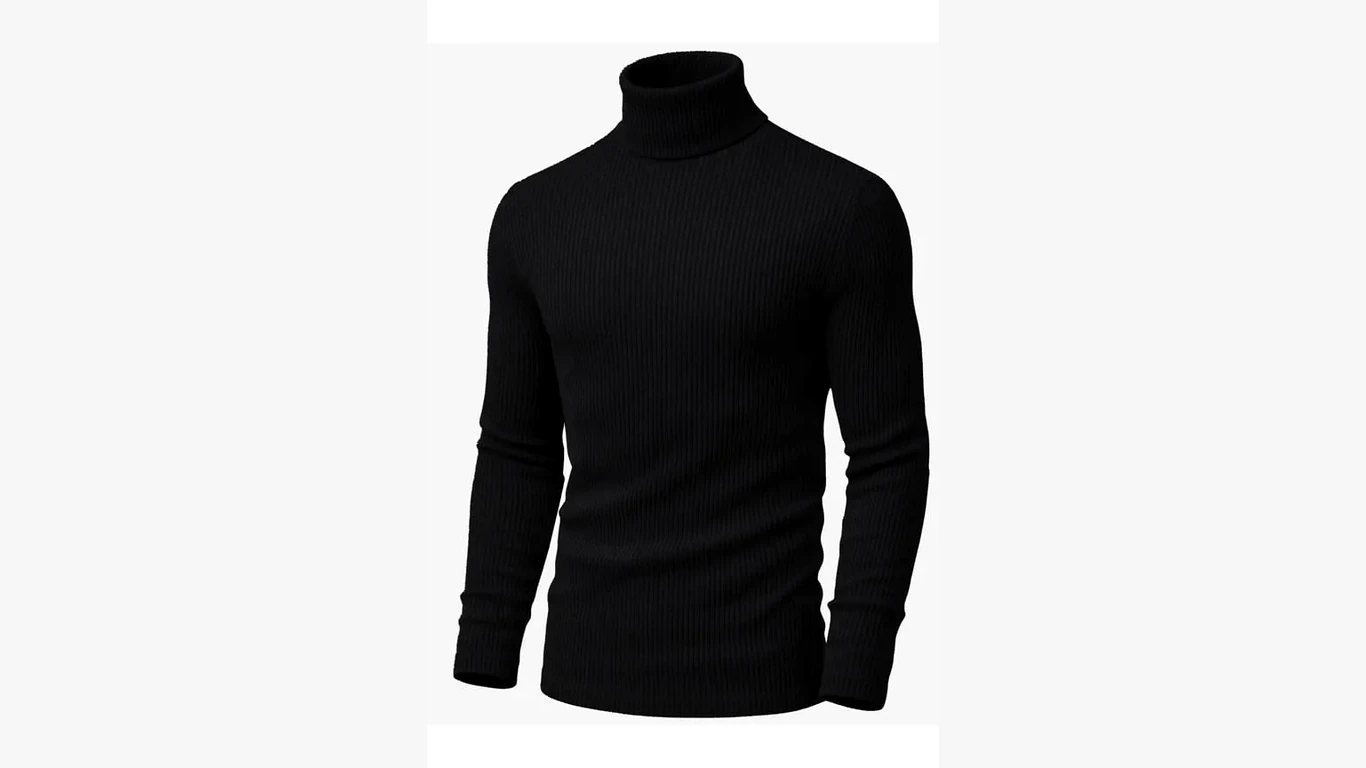

Some garments merely clothe a man while others are attired as declarations of civilization itself. Vidal Sassoon and his perpetual black turtleneck belong firmly to the latter category. It is not simply knit fabric wrapped around the torso and neck. It is a banner of intellect, confidence, discipline, mystery, and masculine refinement. Like a Steinway grand piano resting beneath the chandeliers of an old Manhattan penthouse or the polished walnut dashboard of a vintage Aston Martin, the black turtleneck radiates a quiet authority that does not beg for attention because it already possesses it. Few men in the twentieth century embodied that principle more completely than Vidal Sassoon.
Sassoon did not merely cut hair. He reconstructed modern aesthetics with the precision of an architect drafting blueprints for a cathedral. Before he arrived on the scene, much of fashion and grooming remained trapped beneath a lacquered avalanche of pomade, hairspray, stiff collars, and fussy artificiality. Men looked like exhausted alumni from some moth-eaten chapter of “The Official Preppy Handbook” while women endured elaborate coiffures resembling static sculptures more than living style. Sassoon detonated that exhausted paradigm with geometric exactitude and liberated modern elegance from the prison of ornamentation. In many ways, his embrace of the black turtleneck became the sartorial equivalent of his revolutionary approach to hair. Clean lines. No frivolity. Minimalism infused with virility and intellect.
Born in London in 1928 to impoverished Jewish immigrant parents, Sassoon’s life began not in luxury but in adversity. His father abandoned the family. He spent years in a Jewish orphanage. He endured the Blitz during World War II and later fought in the 1948 Arab Israeli War with the Palmach. The man who would later become synonymous with glamour first understood hardship with brutal intimacy. That struggle forged within him a discipline and hunger that could never be taught in salons or universities. Like a sculptor chiseling marble with relentless patience, Sassoon built himself through force of will, intellect, and vision.
What made him extraordinary was not merely talent. London was full of talented hairdressers. Sassoon possessed something far rarer. He possessed ideological clarity about aesthetics. He viewed hair not as decoration but as structure. He drew inspiration from Bauhaus geometry, modern architecture, and the clean precision of contemporary design. He rejected needless extravagance the way a great conductor rejects a single sour note from the orchestra pit. His cuts moved naturally. They framed the face with mathematical balance. They liberated women from the tyranny of endless rollers and shellacked helmets. In doing so, he transformed himself into a cultural colossus. Accompanying this revolution was the perpetual black turtleneck that became inseparable from his public image.
The black turtleneck had already traversed centuries before Sassoon elevated it into the orbit of modern masculine sophistication. Medieval knights wore high neck garments beneath chainmail to prevent abrasion. Sailors and dockworkers relied upon them against the brutal cold of Atlantic winds. Polo players popularized the “polo neck” variation throughout Britain. By the early twentieth century, the garment migrated into intellectual and artistic circles. Writers, existentialists, jazz musicians, and bohemians embraced it because it projected seriousness without rigidity. It was anti establishment while simultaneously elegant. It could sit comfortably inside a smoky Paris café beside a volume of Camus or accompany a sculptor in a downtown Manhattan loft splattered with oil paint and ambition.
By the 1950s and 1960s, the black turtleneck had become the unofficial uniform of modern creative power. Miles Davis wore it with the cool detachment of a midnight trumpet solo drifting through cigarette smoke. Beatniks adopted it as a rebuke to conformity. European intellectuals transformed it into a symbol of cerebral rebellion. Yet many men still looked performative inside it, as though they were auditioning for sophistication rather than embodying it naturally.
Sassoon was different. He did not wear the black turtleneck as costume. He wore it as extension. On him, the garment looked inevitable. The angular precision of his haircut designs mirrored the streamlined silhouette of the turtleneck itself. His lean athletic posture, sharp features, and disciplined grooming transformed the sweater into something almost mythological. He looked like the human manifestation of modernism itself. While other men appeared swallowed by the garment or overwhelmed by its artistic connotations, Sassoon inhabited it effortlessly. He made it appear masculine rather than theatrical. He gave it entrepreneurial authority rather than bohemian aimlessness. That distinction matters enormously.
A black turtleneck can become disastrous in the wrong hands. On lesser men, it can appear pretentious, sepulchral, or affected. Sassoon infused it with vitality. He paired it with confidence, technical mastery, and undeniable heterosexual masculinity. Contrary to the lazy assumptions often projected onto fashionable men during that era, Sassoon was not gay. He was married four times, fathered four children, adored his family, and built a life balancing immense professional achievement with fatherhood and domestic devotion. He was a family man whose ambition never extinguished his humanity. In many respects, that made his elegance even more compelling. He proved a man could possess refinement without sacrificing virility.
Sassoon’s black turtleneck became the armor of the self made visionary. It communicated that he belonged to the future while the rest of the world remained trapped in the stale upholstery of the past. He looked like a man capable of redesigning civilization with nothing more than a pair of shears and an idea. In photographs from the 1960s and 1970s, he radiates the same magnetism later associated with men like Steve Jobs, though Sassoon possessed infinitely more warmth and charisma. Jobs adopted the black turtleneck as a corporate uniform. Sassoon wore it as a declaration of aesthetic philosophy.
His famous slogan, “If you don’t look good, we don’t look good,” was more than marketing brilliance. It was a credo. Sassoon understood that appearance is not vanity. Appearance is communication. It is architecture for the human form. A man who dresses with discipline announces to the world that his mind likely operates with similar precision. The black turtleneck exemplifies that principle because it strips away distraction. There are no flamboyant patterns, no gaudy embellishments, no ornamental cowardice hiding beneath gimmickry. It places the burden squarely upon the man himself. His posture. His grooming. His face. His confidence. Like a cathedral stripped of clutter to reveal its soaring arches, the black turtleneck exposes character.
Joseph Giustizia, a celebrity hairstylist trained personally by Vidal Sassoon himself, now owns and operates Muse A Hair Salon in Boca Raton, Florida. Reflecting recently on his years working under Sassoon at the famed New York City salon, Giustizia recalled not only the technical brilliance of the legendary stylist but also the discipline, professionalism, and refinement that permeated the entire culture surrounding him. Every employee at the salon dressed in black and projected confidence, precision, and understated elegance. Giustizia explained, “Confident men who understand the value of looking good and feeling great are the most sought after men in business and in life. If you look like you’re worth a dollar, you will only attract a dollar.” The Vidal Sassoon black turtleneck elevated the entire staff into a unified projection of sleek professionalism and modern sophistication. That is precisely why the garment never dies.
Fashion trends expire with embarrassing regularity. Bell bottoms, neon windbreakers, grotesque oversized logos, and countless other sartorial abominations eventually collapse beneath the weight of their own vulgarity. The black turtleneck endures because it is rooted in timeless masculine principles. Simplicity. Strength. Mystery. Elegance. Intelligence. It flatters the body while conveying seriousness of purpose. It is equally at home beside a cashmere overcoat in Manhattan, beneath a tailored blazer in Milan, or paired with dark sunglasses behind the wheel of a vintage Ferrari gliding along the Pacific Coast Highway at dusk.
Sassoon understood this intuitively because he himself was timeless. He rose from poverty and abandonment to become one of the most influential style innovators of the twentieth century. He built salons, academies, products, and a global empire through intellect and discipline rather than inherited privilege. He authored books, educated generations of stylists, and eventually devoted himself to philanthropy and the study of antisemitism. Queen Elizabeth II awarded him Commander of the Order of the British Empire. Hollywood immortalized him. Yet through all the fame and fortune, he retained the aura of the craftsman. The black turtleneck symbolized precisely that synthesis of artistry and rigor.
There are men who wear clothing and there are men who transform clothing into legend. Vidal Sassoon accomplished the latter. The black turtleneck upon his frame became more than fashion. It became a manifesto of modern masculinity. Decades later, its silhouette still whispers the same message across runways, boardrooms, salons, jazz clubs, and candlelit restaurants. Style anchored in discipline and authenticity never perishes. Like Vidal Sassoon himself, it simply refuses to go out of style.