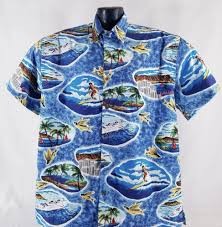

What began as practical island attire transformed into a nationwide trend during the 1950s and 1960s, and beyond, worn by everyone from beachgoers to celebrities to the President of the United States. The Hawaiian shirt, widely known as the Aloha shirt, stands out as one of the most recognizable pieces of casual menswear in American fashion history. Its explosive pops of color, bold patterns, and relaxed fit accentuated the spirit of postwar optimism amidst the growing allure of tropical escapism.
Although the colorful Hawaiian shirt first emerged in the 1950s, it was in the popular TV series Hawaii Five-0 which ran from 1968 to 1980 that the shirt was made popular again for American leisure wear.
This garment surfaced amid the multicultural workforce of Hawaii’s sugar plantations during the late nineteenth and early twentieth centuries. Laborers from places like Portugal, China, Japan, Korea, the Philippines, and elsewhere brought clothing traditions suited for warm climates. These influences meshed over time, creating lightweight, untucked shirts made from cotton, rayon, and other breathable fabrics that could withstand heavy labor in intensely humid conditions.
Early variations included the palaka, often called Hawaiian denim,a sturdy checked jacket with an open collar, inspired partly by European sailor uniforms. Filipino barong tagalog styles contributed to loose, flowing cuts, while Chinese silk embroidery and Japanese yukata fabrics introduced more vivid colors and intricate prints. This combination of both practicality and artistry laid the foundation for what would become the modern Hawaiian shirt.
One very early example featured geometric bamboo motifs, which quickly caught the eye of young men in Honolulu as a comfortable alternative to formal wear. By the 1920s, the shirt began taking its familiar shape as locals experimented with custom designs, often using Japanese kimono cloth repurposed into short-sleeved, open-collar garments. One very early example featured geometric bamboo motifs, which quickly caught the eye of young men in Honolulu as a comfortable alternative to formal wear.
In the mid-1930s, Japanese tailor Koichiro Miyamoto, operating under the name Musa-Shiya, advertised ready-made Aloha shirts featuring radiant tropical patterns. Around the same time, Ellery Chun trademarked the phrase “Aloha Shirt” and moved toward mass production, employing local seamstresses and artists to create designs inspired by island flora, fauna, and scenery. These efforts helped turn the garment into a small, evolving export industry.
The Second World War accelerated the shirt’s circulation. After the attack on Pearl Harbor, American servicemen stationed in Hawaii purchased colorful rayon versions as souvenirs. When fabric imports from Japan stopped, manufacturers switched to domestic materials and emphasized native Hawaiian themes such as hibiscus, palm trees, and volcanic landscapes. Soldiers carried these “silkies” back to the mainland, introducing the style to the rest of the country.
After the war, Hawaii’s tourism industry boomed. Visitor numbers climbed dramatically, and demand for authentic island souvenirs soared. The Hawaiian government supported local manufacturers, leading to dozens of companies producing shirts with increasingly elaborate prints. Designers incorporated influences from Polynesian, Asian, and even Latin American art, creating a rich visual vocabulary that appealed to mainland tastes.
One of the most influential figures was Alfred Shaheen, who launched his label in 1948. Shaheen’s workshop produced high-quality shirts with hand-screened designs that fused Hawaiian motifs with Chinese and Japanese elements. By the early 1950s his company had become one of the largest producers, supplying retailers nationwide and helping cement the shirt’s place in popular culture.
Films set in Hawaii, featuring vacation themes showcased actors in vibrant Aloha shirts, playing a major role in mainstreaming the garment. Stars such as Montgomery Clift, Frank Sinatra, Bing Crosby, and Bob Hope appeared in them on screen, associating the style with leisure, glamour, and carefree living. Television appearances and magazine spreads further amplified the trend.
The 1950s marked the peak of the Hawaiian shirt’s popularity. Postwar prosperity allowed middle-class Americans to embrace casual fashion, and the shirt fit perfectly into the era’s growing emphasis on relaxation and outdoor living. Suburbia, backyard barbecues, and family road trips created ideal settings for its bold, informal aesthetic.
President Harry S. Truman became one of the garment’s most prominent advocates. During his frequent winter vacations in Key West, Florida, starting in 1946, Truman sought comfortable clothing for the warm climate. After initially wearing standard dress shirts, he switched to lightweight sport shirts, eventually adopting brightly patterned Hawaiian styles sent by admirers and local merchants.
Truman wore these shirts during public appearances and photo sessions, drawing widespread media coverage. Newspapers described the patterns as “spiffy” yet “much too loud,” but the President continued wearing them for days at a time. He even turned the habit into a tradition, hosting informal contests among staff to judge the most outrageous designs.
The President’s endorsement carried a significant cultural weight, as the leader of the free world he appeared relaxed and approachable in floral prints, the shirt shed any lingering stigma of being solely tourist attire. It became acceptably fashionable, for men of all backgrounds to wear bold patterns in everyday summer settings.
Throughout the 1960s the Hawaiian shirt retained strong appeal, though its dominance began to wane slightly as fashion trends shifted toward mod styles and minimalism. Still, it remained a fixture at beach parties, backyard gatherings and casual offices, especially in warmer regions. Vintage designs from the golden era continue to inspire collectors and revival collections today.
On August 21,1959 Hawaii became the 50th star on the American flag. This solidified a national sense of pride and optimism. After many years of territorial status, wartime scars from Pearl Harbor, and Cold War strategic imperatives, the islands’ admission symbolized America’s capacity for inclusion, expansion, and renewal.
In the fullness of time, the Hawaiian shirt represents more than fabric and print. It embodies a moment when America embraced color, comfort, with a drop of exotic escapism in daily life. From the plantation fields of Hawaii to the White House lawn, its journey reflects cultural exchange, postwar joy, and the enduring appeal of dressing for sunshine.