Update: As requested in light of today’s news, we revisit our interview with Roger Stone for you to bemoan or celebrate the verdict on his trial.
After the publication of Friday’s story on political supervillain Roger Stone, contributing writer Eric Twardzik received an unexpected call from Stone, leading to an exclusive interview in which the Machiavellian manipulator discusses his interest in tailored clothing, which includes a deep appreciation of traditional American style.
ET: In the documentary “Get Me Roger Stone,” you’re seen wearing a patch-madras sportcoat.
RS: It is one of two that I own. Finding it in three buttons was a challenge; it’s actually from Joseph Banks and is my favorite. I don’t have any single-breasted jackets at all that are not three-button, but most of the time I wear double-breasted suits.
ET: Do you wear the madras to be bolder and to fit into a persona, or has that always been something you gravitated towards outside of your public persona?
RS: I don’t really know where I come by this. I come from a blue-collar background and grew up in Fairfield County, Connecticut. Neither of my parents went to college. But when I first started going to elementary school I told my mother I wanted a button-down, all cotton Brooks Brothers shirt and corduroy slacks. And the whole idea of any non all-natural fabric being on your body has always turned me off.
When I was younger I had 44-inch shoulders but a 31-inch waist, which meant you could never buy a suit off the rack. So I started having things custom made. That’s a slippery slope, because pretty soon you realize that you can have ticket pockets and watch pockets, and peak lapels and I made a bunch of things with three buttons but peaked lapels. For a while I was having things made for me by Anderson & Sheppard in London, and then I discovered Alan Flusser. Throughout the ’70s and ’80s he made most of my clothes. “Look good feel good” is one of my rules.
Madras is not only great looking, in the heat of Washington DC it’s very comfortable. And patchwork is great cocktail party stuff. I also have a lot of pants made out of the same thing, that you wear with a blue blazer or a bottle green blazer. Washington is, of course, the home of the worst-dressed men on the face of the planet. Nobody there cares about looking good. Nobody thinks about what looks good in terms of either cut or color. It’s a wasteland, always has been. There is a J. Press store there, but that’s a positive development that’s fairly recent. To shop you’ve got to go to New York. I used to go to Chipp, I have this unbelievable kind of sunburst jacket. I wore it to a party that Milo had last weekend. I don’t want to be like everyone else. I’ve got my political style and the way I dress is really the same, in a sense.
ET: Conservative American style has become almost a counter-cultural statement.
RS: Kind of the pure American style — like the Kennedy brothers, Jack and Bobby and Ted Kennedy were all incredibly well dressed. At the same time, they all looked like they never put a second’s thought into it, it was just natural. Jack Kennedy is essentially the guy who popularized the two-button suit. Ironically, the first one he had made in London when his father was the ambassador to Britain. Prior to that the three-button suit was the pretty standard model. Also, when he went to the inauguration in 1960 without wearing a hat, that’s it for men’s hats. Almost immediately, they’re gone as a fashion must-have. In the ’50s, no man would leave the house without his hat. By 1961, no man is wearing a hat. So politics, and kind of the showbiz aspects of politics, have changed entirely our perceptions of what’s fashionable, what’s stylish, and so on.
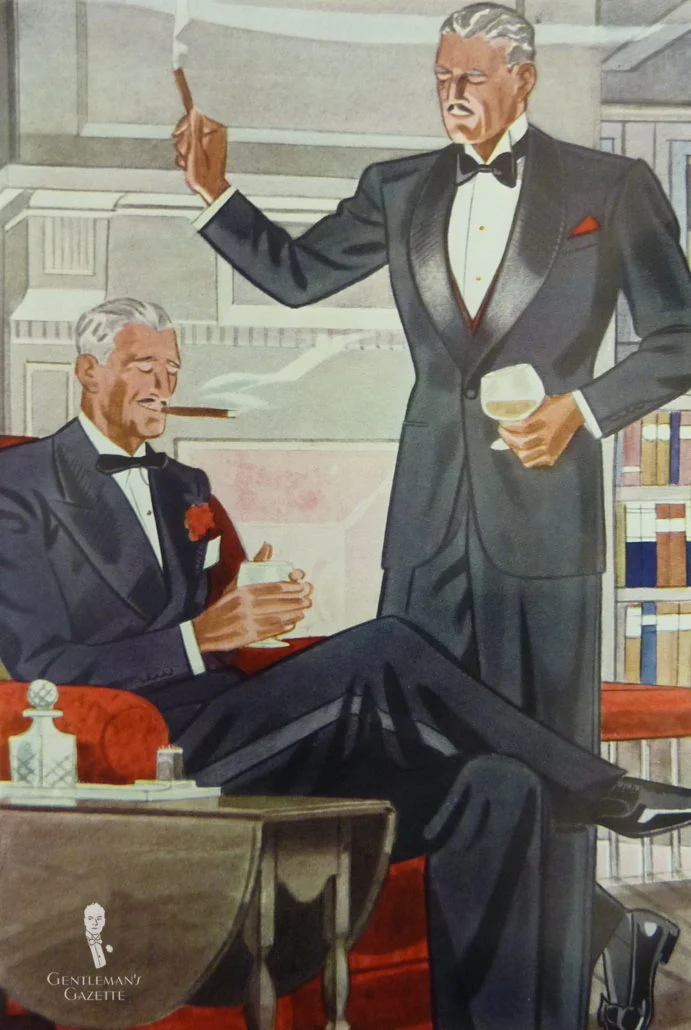
One of the great disappointments is that for presidential inaugurations every president used to wear a morning suit. That’s what the etiquette books called for. Reagan did, Nixon did, Johnson did, Kennedy did, Truman did, and they all looked great. And then they’d wear white tie at the inaugural ball in the evening. George Bush is responsible for ending that. He wore a dark business suit and a formal tie to his inauguration and that’s it. I tried to talk Trump into wearing a morning suit, and he said “no way.”
–

–
ET: You wore a morning suit to the inauguration, correct?
RS: Yes, because that’s what the etiquette book calls for. Now some of my critics said I look like a vampire, but who gives a fuck what they think. Today, rogerebert.com has a review of the film “Get Me Roger Stone” out, and he’s [film critic Godfrey Cheshire] trashing my clothes in it. Take a look at his pictures. This guy has no taste. He wants to attack my politics, that’s fine, don’t attack my clothing. You know nothing about it. You’re a tasteless fool.
ET: Is there something specific about Ivy style that you, as someone who did not come from a Kennedy-esque background, found attractive?
RS: It’s so pure. First and foremost, it’s comfortable. Which is the purpose of clothes. Beyond that, it’s just pure. And it never changes. It doesn’t matter if you’re wearing a navy blue blazer in 1920 or if you’re wearing it in 2017, it still looks great. Fashion changes. But style never changes. Ties get wider, ties get thinner, but a mid-width tie will always look good.
ET: When did you first start dabbling in the Ivy League Look?
RS: I was making my mother get me these all-cotton buttondown shirts when I was in the first grade, and I wouldn’t wear anything that was a blend, so fairly early. I couldn’t afford quality things until I got out of college. I had a couple great tweed jackets when I was in college that I wore, a couple club ties, and mostly wore khakis. This was a time when nobody who was going to college ever wore a tie. I wore a tie to class everyday. It’s just part of who I am, I guess. If I hadn’t been in politics I’d probably be designing men’s clothes.
ET: When you were young, wearing ties to school, was there a particular haberdashery or men’s shop you would go to?
RS: This is just before the advent of Ralph Lauren. I wore Brooks Brothers stuff, mostly. This was before Brooks Brothers was destroyed. I moved to Washington in 1970 and I went to work for Nixon. There was a guy working for Nixon named Ken Reeds. I saw Ken Reeds wearing a Polo tie, a Ralph Lauren tie. It was the coolest thing I had ever seen. He also had Gucci loafers. So as soon as I could afford them I started buying Polo ties and got the Gucci horsebit loafers.
ET: Were those the original Ralph Lauren ties?
RS: Yes, with the horse themes. And I still have them. I never throw anything out.

ET: Are there retailers today that you think are doing a good job with the Ivy Look?
RS: Kamakura. They’re fabulous. Their spread collar shirt is what I wear with a suit, always. The quality of the manufacturing is just terrific. I don’t know how they sell that shirt for $79.99. I’ve recommended them to so many people. There’s a lot of younger guys approaching me about advice on building a wardrobe, and what are the basics. I walk through the fact that it’s better to pay a little more for quality and take care of the garment, and it’ll last you a lifetime, as opposed to buying something less expensive. I like to say, “Good things are not cheap. And cheap things are not good”
ET: Are there other contemporary makers that you’re satisfied with?
RS: It’s hard. You have to do a lot of shopping. You can still find a few things in Brooks that are pretty good. You can still find a few things in J. Press. You can certainly still find pieces at Ralph’s, from time to time they have something that is a must-have. But that’s about it. I like the Stubbs & Wootton slippers. I have custom monogrammed pairs in green, burgundy, black and blue.
ET: There is often debate over what president has best embodied the Ivy style. Some point to Kennedy, some say he killed it, some hold up George Bush the first. What are your thoughts?
RS: I think Kennedy’s the standard. Everything about him is effortless. That’s kind of his charm. He’s very low key and he doesn’t look like he’s put together. George HW Bush is buying his stuff from one particular haberdashery in Washington, its name escapes me. This is a guy who sore short-sleeve buttondown shirts with a tie, which should require the death penalty, as far as I’m concerned. I never thought he was a particularly great dresser, I only thought he was okay. And Franklin Roosevelt’s a great dresser, it’s not the Ivy Style so much as it’s a classic American style, but then he dresses it up with a naval officer’s cape, and those pince-nez glasses that have been out of style for 20 years. It’s almost a costume, or part of his imagery.
ET: Do you think American politicians can ever return to style? Or are people are afraid to look stylish because they’re afraid of what will be said about them?
RS: You don’t want to look like you’re above the voters, that’s the problem Reagan’s style worked very well for him. He had most of his suits made in the ’40s and ’50s, and he never threw them out. Nancy Reagan was always trying to get him to get rid of things. Particularly this one particular brown suit that he loved, and she hated. It’s a weird fabric, it had sort of a faint blue stripe in it. I used to kid him that it looked like the material in the seats of a 1959 DeSoto. He looked good in everything, because he was so physically fit. When he went riding he’d wear jodhpurs with his boots and Lyn Nofziger, his press secretary would always tell him, “you can’t wear that, you have to wear jeans and cowboy boots,” and Reagan would never relent.